Suara Malaysia–Tagalog: The Voice from Sabah That Spoke to Filipino Listeners
Launched in 1973, Malaysia’s Tagalog service reached across the sea before moving online. Its history connects public diplomacy, powerful transmitters and the experience of finding distant voices on a radio dial.
At 9:30 p.m. on August 2, 2008, a listener in Barangay Jordan, Villaba, Leyte, recorded the closing moments of a Tagalog broadcast. His log noted the station identification, its frequency and a national anthem. The signal was Suara Malaysia on 1475 kHz. The observer, Norwegian radio enthusiast Geir Stokkeland, had encountered a Malaysian voice speaking to the Philippines in a familiar language.
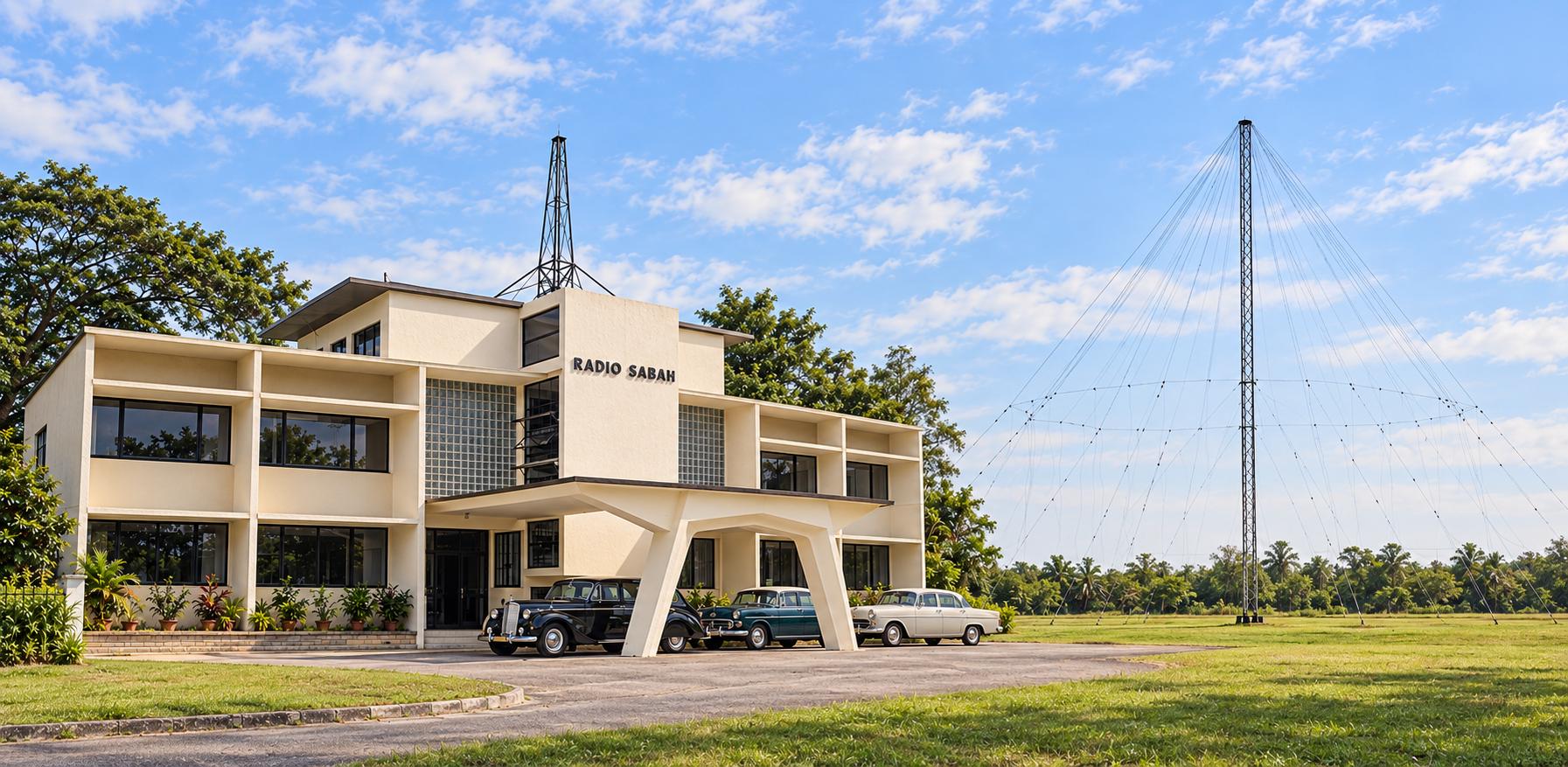
That dated entry preserves a small piece of a much longer broadcasting story. Suara Malaysia–Tagalog, part of Malaysia’s government broadcasting service, began operating on October 1, 1973, according to RTM’s account of its closure. Its broadcasts were associated with Radio Malaysia Sabah and the medium-wave transmitting facility at Tuaran, near Kota Kinabalu.
For a Philippine reader unfamiliar with the name, Suara Malaysia means “Voice of Malaysia.” The Tagalog service gave that name a particular meaning: a neighboring country addressing Filipino listeners in their own language. The Malaysian government described its purposes as explaining government policies, introducing Malaysia’s cultures and ways of life, and strengthening friendship between Malaysia and the Philippines. Southern Philippine listeners were a particular intended audience.
Those objectives also explain why the station belongs in a history of international broadcasting. Its task included presenting Malaysia’s perspective abroad. Music and cultural programming could make that relationship approachable, while information about the country and its policies served a diplomatic purpose. Understanding both sides of that remit helps explain why a Malaysian broadcaster invested in a Tagalog service.
The larger international broadcasting operation predated it. A historical account published by Malaysia’s Dewan Bahasa dan Pustaka traces the overseas service to February 15, 1963, initially as Suara Malaya. Its subsequent development included broadcasts in several languages. The Tagalog operation in Sabah formed a distinct part of that wider story, with a different location and transmission arrangement from the better-known shortwave facilities at Kajang, near Kuala Lumpur.
That geographical distinction matters. Listeners and online histories sometimes discuss Suara Malaysia as though every service used the same transmitters. The Philippine-directed Tagalog broadcast was documented on medium wave, the AM band, at 1475 kHz. Stokkeland’s reception record places it among the AM stations he heard during his Philippine visit. The minister’s later history likewise identifies the Tuaran medium-wave facility.
There is a physical reason an evening broadcast could connect such places. At night, medium-wave signals can travel well beyond their daytime service areas through the ionosphere, a process known as skywave propagation. NOAA explains that changes in the ionosphere after sunset allow AM signals to return to Earth at greater distances. The dial could therefore carry voices from well beyond the listener’s immediate surroundings.
For the human side of the story, Stokkeland’s account offers something more useful than an invented nostalgic scene. He described listening conditions in Leyte, including irregular electrical noise that sometimes obscured most distant stations. His equipment included an Icom IC-7000, a loop antenna and a wire antenna; he also brought a Sony ICF-SW7600GR for portable listening. His log records the Malaysian broadcast amid Philippine stations and other signals from across the region.
His experience cannot stand in for every Filipino household, but it captures the practical activity behind distant listening: knowing when to listen, recognizing a language or station identification, and separating one signal from another. For a history feature, that is a tangible connection between an international broadcaster’s ambitions and what actually reached a radio in the Philippines.
Other reception reports help recover the sound of the station. Listeners on a 2007 expedition to Haida Gwaii, Canada, recorded Tagalog announcements, pop music and news on 1475 kHz. John Bryant called it an “old off-channel friend,” while Walter Salmaniw described occasions when reception was easy to follow. These were enthusiasts far outside the intended Philippine audience, but their observations preserve traces of the programs traveling outward from Sabah.
The engineering behind that reach was substantial. A published 2002 reception account described Suara Malaysia as a 700-kilowatt station. A separate 2008 technical discussion identified a four-mast directional installation at Tuaran, distinguishing it from nearby Sabah shortwave facilities. These are historical monitoring records, rather than a complete RTM equipment inventory, but they establish the scale and physical character reported for the AM operation.
The transition away from that listening experience began well before the final closure. In the minister’s 2022 account, the Tagalog service was converted to online radio on July 1, 2011, because demand for Tagalog content remained. That distinction is essential: the service’s survival until 2022 does not mean its powerful medium-wave broadcast continued unchanged throughout those years.
The broader Suara Malaysia operation was also changing. The Dewan Bahasa dan Pustaka retrospective describes the international shortwave service moving toward internet delivery in 2011, followed by closure in 2012. The Sabah-based Tagalog service outlasted that wider operation, continuing its separate chapter until April 2022.
By then, the Malaysian government judged that the original case for maintaining the service had weakened. RTM reported declining audiences and said existing FM services in Sabah were considered adequate. The Cabinet approved termination on March 4, 2022, with resources intended to support improvements elsewhere in RTM Sabah.
The minister’s subsequent statement added another consideration: Malaysia’s Foreign Ministry no longer regarded the service as making an important contribution to bilateral diplomacy. The account published by Bernama therefore linked closure to audience size, effectiveness and resource allocation. April 30, 2022 became the recorded end of the Tagalog service, nearly 49 years after its establishment.