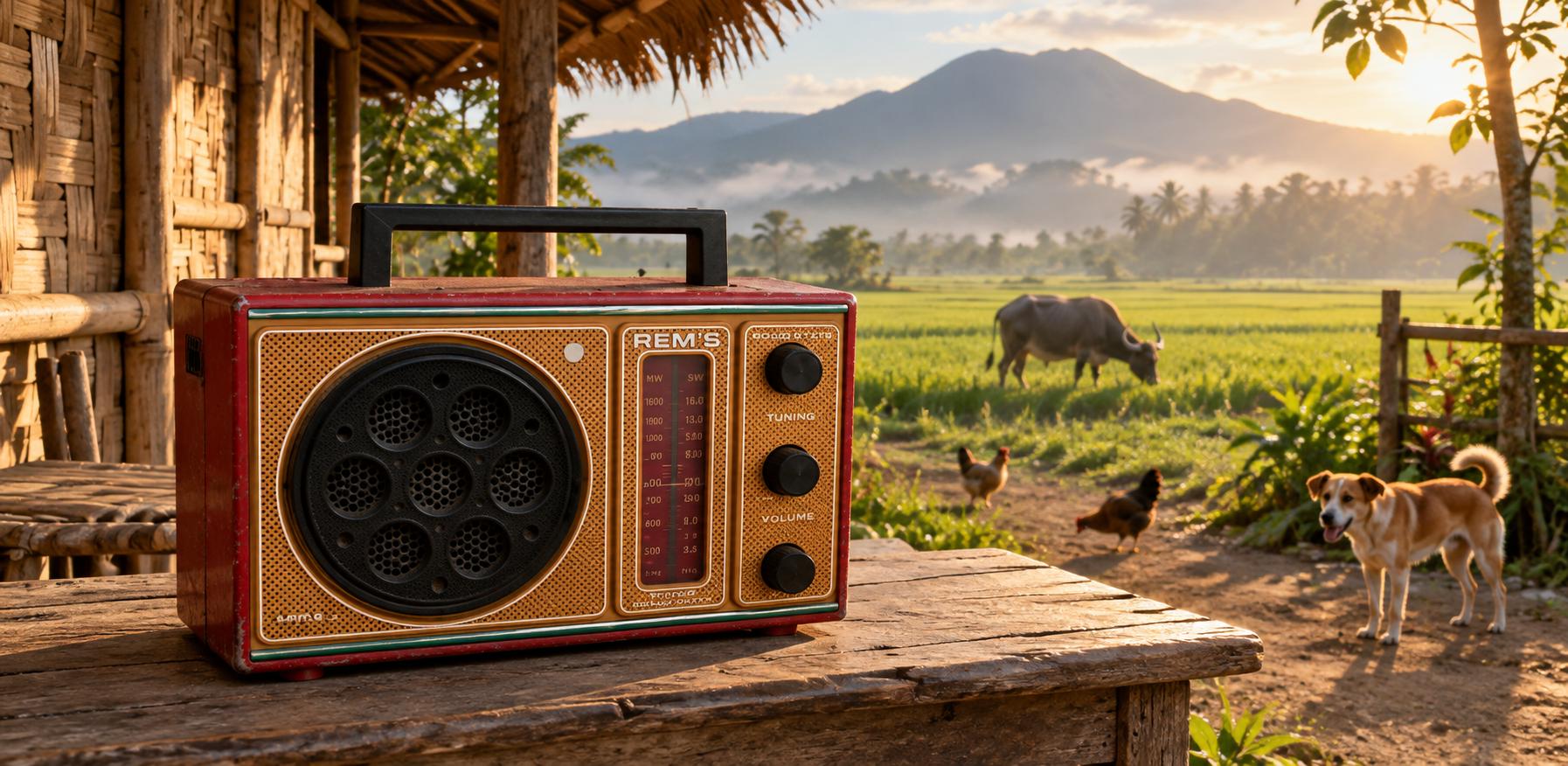
REM’S Transistor Radio: Four Batteries and a House Full of Voices
I remember the small negotiation that came before changing the station.
Someone would reach for the tuning knob, and someone else would object. There was a drama to finish, a piece of advice to hear, or a familiar voice about to come on. Whoever had a hand on the radio did not necessarily have the final say.
That is how I remember a REM’S transistor radio: surrounded by people who had something they wanted to hear.
The handle, the circular speaker grille, the narrow tuning scale, and those four D-size batteries belong to the picture. But when I think of the radio now, the voices arrive first.
There is Lola Sela Bungangera, ready with a sharp remark. Tita Swarding, bringing showbiz chatter into the room. Tiya Dely, listening patiently to somebody’s troubles. And, when I was feeling brave enough, Gabi ng Lagim.
They made it very difficult to switch the radio off.
REM’S is one of those names that can send a Filipino radio listener back to the 1990s. The examples accompanying this story have a box-shaped cabinet, a top-mounted carrying handle, a large circular speaker grille on the left, and a vertical tuning scale beside three rotary controls. Some have wood-look finishes; others stand out through their red, blue, green, or gold-toned front panels.
The portable AM set remembered here ran on four D-size batteries. To get started, you needed usable batteries, a station within reach, and a little patience with the tuning knob.
I remember that patience. You turned slowly, listened through the crackle, passed a voice, then turned back to find it again. Once the familiar program came through clearly enough, the hand left the knob.
There. Leave it there.
My memories of DZRH have several different moods, and Lola Sela occupies the liveliest corner.
The name was Lola Sela Bungangera, the radio persona of actress and broadcaster Eloisa Cruz Canlas. In the 1990s, Canlas brought that outspoken grandmother into Joe Taruc’s Balitang Bayan Numero Uno, offering comments, criticism, and advice. A University of the Philippines tribute records how the character became a vehicle for speaking about public affairs.
As a listener, I enjoyed the feeling that somebody’s fearless lola had entered the discussion. Her sharp tongue gave the news a recognizable human character. I could laugh at the delivery and still pay attention to what she was complaining about.
Then there was Tita Swarding, whose showbiz commentary added another kind of excitement to DZRH. Even without a photograph in front of me, I could follow the personalities, disagreements, and developments being discussed. The delivery was part of the attraction; Tita Swarding made entertainment news sound like a conversation worth staying for.
Tiya Dely brought a different pace.
With her, I listened more quietly. Fidela Magpayo, the woman generations knew as Tiya Dely, made room for people’s problems on the air. Her work included counseling and Kasaysayan sa mga Liham kay Tiya Dely, which brought listeners’ letters into the world of radio drama.
There was something compelling about hearing another person’s difficulty unfold through that small speaker. A family quarrel, an unhappy relationship, a decision with consequences: these were situations a listener could recognize, even when the circumstances were different from one’s own.
I might begin by wondering what happened. Before long, I would be wondering what I would have done.
And then Gabi ng Lagim would test my confidence.
I liked to think I could listen without being frightened. That confidence was easier to maintain before the story started. Once the voices, pauses, music, and effects took over, an ordinary sound elsewhere in the house could become unusually interesting.
Radio horror left plenty of work to the imagination. I supplied the dark passage, the threatening figure, and the face that nobody had actually shown me. DZRH’s long-running horror drama understood how much suspense could travel through sound.
The REM’S could remain perfectly still on a table while, in my head, someone was already running for their life.
That was part of the pleasure of being a radio fan. A single receiver could take me from laughter to sympathy to suspense, with news and commentary between them.
Drama, especially, gave listening a schedule. An episode ended, but the problem remained unresolved. I wanted to know whether a secret would finally come out, whether the wrong person would be blamed, or whether a character would get another chance.
The following day’s broadcast mattered because I had already invested something in the story.
This attachment helps explain why a transistor radio earned its place in a home. Portability was useful because people wanted to carry a program with them. Batteries mattered because they allowed the listening to continue.
Across the Visayas and Mindanao, the dramas associated with Radyo Agong and Bombo Radyo gave listeners their own appointments with AM radio. Cebuano and Hiligaynon programming brought familiar expressions and ways of speaking into the stories. Regional station histories document drama as part of that broadcasting tradition.
I would not pretend that every household followed the same station or that every REM’S owner bought a set for drama. But I recognize the habit: find the program, make yourself available to it, and hope nobody changes the dial.
Those four D-size batteries deserve a place in the memory, too. We had to make them last.
Today, it is easy to leave a plugged-in speaker playing for hours. In a household relying on disposable batteries, every unnecessary hour of listening brought the next purchase closer. I learned to think about how much radio I could afford to hear before the sound began to weaken.
We kept the volume modest. Loud enough to follow the dialogue, low enough that someone would not complain we were wasting the batteries. If hearing the story meant moving a little closer to the speaker, then we moved closer.
We also chose when to switch it on. A favorite drama, the news, Tiya Dely, or another program worth waiting for: those were reasons to use the batteries. Leaving the radio playing to an empty room could earn a reminder to turn it off.
Sometimes I watched the time because I wanted to catch a program from the beginning without using up the batteries while waiting.
Eveready belongs in this memory. Its Philippine battery-making history stretches back decades, and its Cebu factory produced D-size carbon-zinc cells. National/National Panasonic also had an established local battery operation; the company records a new UM-1 finishing line in 1990.
I cannot recall how much a single battery cost in the 1990s because I wasn’t the one buying them—my parents were. But I remember the calculation: could the ones already inside the radio carry us through another episode?
When the sound grew weak or distorted, we became reluctant to admit that the batteries were finished.
Out they came. Some were left in the sunlight, in the hope that a little heat might bring them back. Others were squeezed, their metal bodies pressed in the belief that there was still something useful to be coaxed out.
Baka puwede pa.
That was the hope each time we put them back and turned the knob. We leaned toward the speaker, listening for enough of a voice to follow the story.
Then there was the business of deciding which cells still had something left. Four batteries installed together did not necessarily end up with identical remaining usable capacity. A weak cell could limit the performance of a series-connected set.
We wanted to keep the ones we thought could still work. And yes, I remember the tongue test: that brief sting, and the confidence with which we treated a stronger tingle as a sign of more life left in a battery.
It was an improvised judgment, passed around with the certainty of something everybody seemed to know. We were trying to save ourselves another purchase and hear a little more radio.
Those habits explain something important about listening then. We rationed the volume and the hours. We tried to stretch a weakening set because there was a program we did not want to miss.
The early 1990s gave Filipinos plenty of reason to appreciate that. A World Bank study records brownouts averaging seven hours a day in many regions during 1992–1993, with some interruptions lasting as long as twelve hours.
Looking at a surviving REM’S today, I find myself wanting to know whose room it once occupied.
Who chose the station? Who remembered to buy the batteries? Who laughed at Lola Sela, followed Tita Swarding, or listened carefully when Tiya Dely began to speak?
For someone who lived with radio, the sight of that cabinet can bring back an entire listening routine. I can almost feel the resistance of the tuning knob and hear the voice becoming clearer as the pointer settles into place.
Then comes the familiar request from somewhere nearby.
Leave it there. The program is starting.




Log in to join the discussion and leave a comment on this article.
Log in to Comment