The First Radio Broadcast in the Philippines: A Small Signal in 1922
Before radio became a companion in Filipino homes, a source of breaking news, and a lifeline during emergencies, it began as an experiment. A transmitter sent sound into the air, and a small audience with receiving equipment listened for what would come through.
The beginnings of Philippine radio broadcasting are generally traced to 1922, during the American colonial period. One of the earliest—and commonly credited as the first—test broadcasts was conducted by an American woman identified in historical accounts only as Mrs. Redgrave, using a five-watt transmitter at Nichols Field near Manila.
That account is important, but it comes with gaps. The histories consulted do not establish a precise day, a verified opening announcement, or the first song transmitted. The story is therefore best understood through three related milestones: Redgrave’s early experiment, Henry Hermann’s experimental stations in 1922, and the development of KZKZ in 1924.
The year itself has strong institutional recognition. In 2022, the University of the Philippines Diliman marked a century of broadcasting in the country, identifying 1922 as its starting point. The centennial examined how a medium introduced under American rule eventually became part of Filipino cultural life.
Mrs. Redgrave occupies an unusual place in that history. She is remembered for a technical achievement, yet the available accounts offer little of her personal story. Radio historian Adrian Peterson’s account also places her five-watt experimental station at Nichols Airfield in 1922. His suggestion that she may have been connected to airfield personnel is explicitly a presumption, rather than an established biographical fact.
Remembering her contribution does not require filling those gaps with an invented first name, occupation, or dramatic speech. What survives is the account of a woman participating in broadcasting’s earliest experiments in the country—before there was an established Philippine radio industry to join.
Later that year, the story becomes more closely connected with business. In June 1922, American businessman Henry Hermann, owner of Manila’s Electrical Supply Company, began experimental broadcasting. John A. Lent’s historical study describes three 50-watt stations operating under temporary permits in Manila and adjoining Pasay. Their programs consisted largely of music for the relatively few people who owned receivers.
Amy L. Forbes’s later historical account identifies the three installations as stations in Manila and Pasay and a third portable station. These were experiments conducted before Hermann established the more recognizable station KZKZ.
Hermann was exploring whether broadcasting could become a business. The Broadcast Archive’s account, prepared with assistance from media historian Elizabeth L. Enriquez, describes his interest in sending music to receiver owners and testing radio’s commercial potential. Broadcasting gave an electrical supplier something to demonstrate: a receiver was more attractive when there was something worth hearing on it.
For those early listeners, the experience demanded more attention than pressing a preset button. Receiving equipment was still developing. A surviving American Kennedy receiver from 1923, documented by the Smithsonian, has separate controls and headphone connections. It illustrates the equipment available in that period, although it does not establish which receivers the first Philippine listeners actually used.
The human significance lay in the separation between performer and listener. Music could be heard without being in the room where it was produced. The person operating the receiver became part of an audience that the broadcaster could not see. Familiar today, that relationship was still being built in the Philippines.
The early transmitter figures also show how modest the beginnings were:
| Stage | Date | Reported transmitter power |
|---|---|---|
| Mrs. Redgrave’s test at Nichols Field | 1922; exact date not established here | 5 watts |
| Hermann’s experimental stations | June 1922 onward | Three stations rated at 50 watts each |
| Hermann’s replacement station, KZKZ | 1924 | 100 watts |
| KZKZ under the Radio Corporation of the Philippines | Later in 1924 | Increased to 500 watts |
These figures describe successive experiments and station development, rather than a single transmitter that remained unchanged. They are reported in historical accounts; the sources consulted do not identify a verified manufacturer or model for Redgrave’s apparatus.
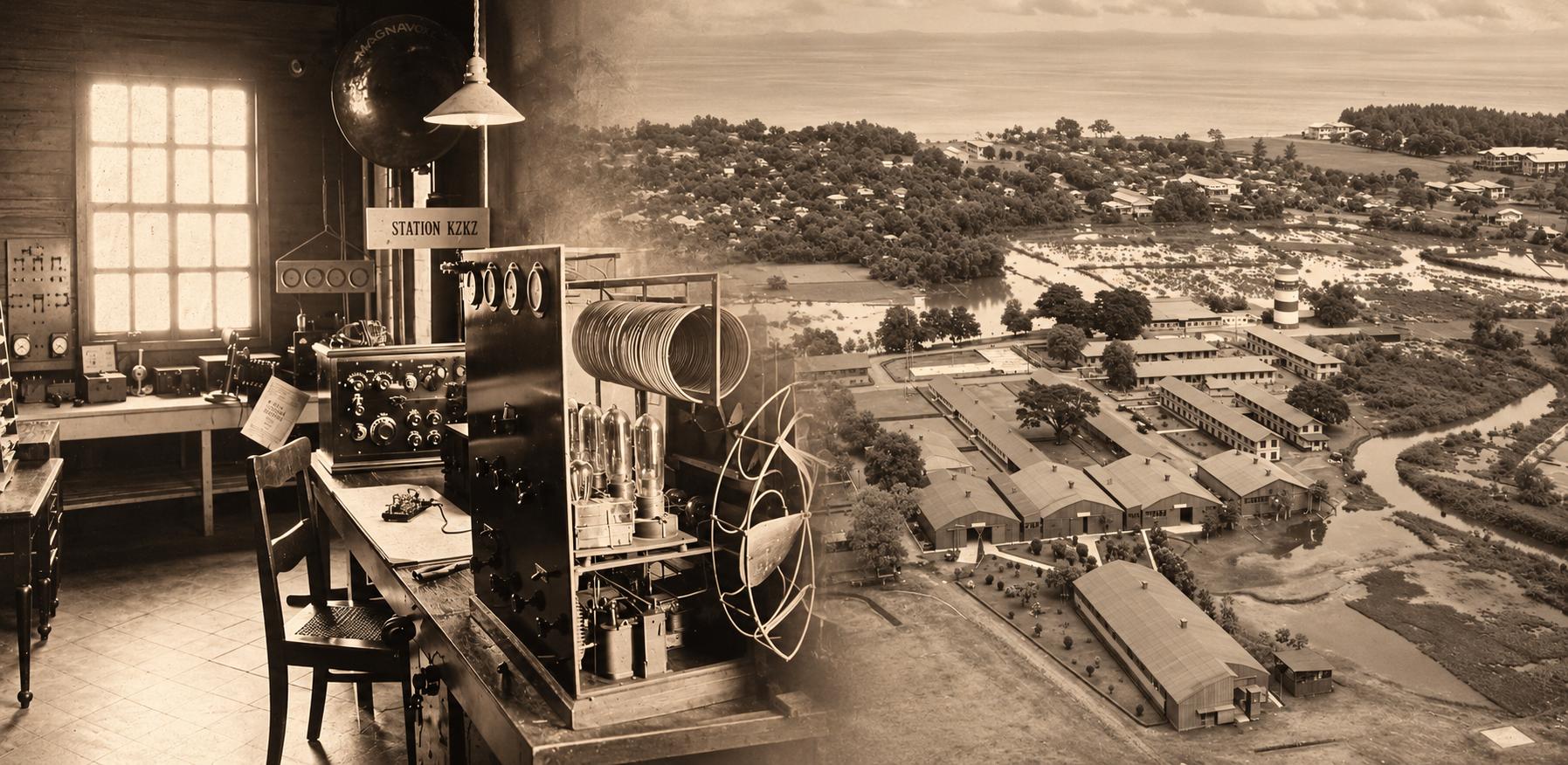
By 1924, Hermann had replaced his experimental installations with a 100-watt station carrying the call letters KZKZ. On October 4, 1924, he sold it to the Radio Corporation of the Philippines. Its power was subsequently increased to 500 watts. This transition helped move broadcasting beyond a small electrical-business experiment toward a more organized commercial undertaking.
KZKZ explains why some accounts give 1924, rather than 1922, as the beginning of Philippine radio. The earlier year refers to experimental broadcasts; the later year is associated with a formally identified broadcasting station. A station history drawing on contemporary records identifies KZKZ as the first standard broadcasting station authorized in the Philippines and lists its 1924 authorization on 1110 kHz. That frequency should not be assigned retrospectively to Redgrave’s separate 1922 experiment.
The distinction also prevents another misunderstanding: KZKZ was not simply an earlier name for every familiar station that followed. Lent records that a 1925 merger left KZRQ operating while KZKZ ceased broadcasting. He separately dates the establishment of KZRH—the predecessor of DZRH—to July 14, 1939. These stations belong to different stages of the country’s radio history.
The first broadcasts also need to be understood within the society that produced them. In 1922, the Philippines was under American colonial rule. Enriquez explains that American businessmen introduced broadcasting with encouragement from a colonial administration that recognized its ability to spread American culture, particularly through English and Western music.
But Filipino broadcasters, performers, and audiences gradually shaped the medium themselves. Stations needed material to fill their airtime, creating opportunities for Filipino singers and instrumentalists. Enriquez describes how Filipino songs, kundiman, folk music, and musical hybrids found space alongside Western repertoire. The same technology used to promote a foreign culture became a channel through which Filipino musical expression persisted and developed.
This was the larger transformation that those small experimental signals helped begin. Broadcasting’s importance would depend on more than transmitter power. It would depend on the people who supplied the songs, the languages listeners understood, and the reasons audiences returned.
Why, then, is the first broadcast so difficult to reconstruct precisely? A University of the Philippines report on Enriquez’s research explains that wartime destruction eliminated much of the country’s broadcasting documentation. Her work brought together surviving archival materials, oral histories, recordings, newspapers, and magazines to recover parts of that history. The missing details reflect the difficulty of preserving the record of a medium whose original product was sound passing through the air.
The most responsible account therefore begins with 1922 and the early test attributed to Mrs. Redgrave, continues through Hermann’s experimental music broadcasts, and distinguishes those beginnings from KZKZ’s development in 1924.
There may be no verified first sentence to place in quotation marks. What the record preserves is the beginning of a new relationship: someone transmitting, someone listening, and sound connecting people who were no longer required to share the same room.
From that small beginning, Philippine radio would become something far larger than an electrical demonstration. It would become a place where Filipinos heard music, recognized their languages, followed events, and found company in a voice.