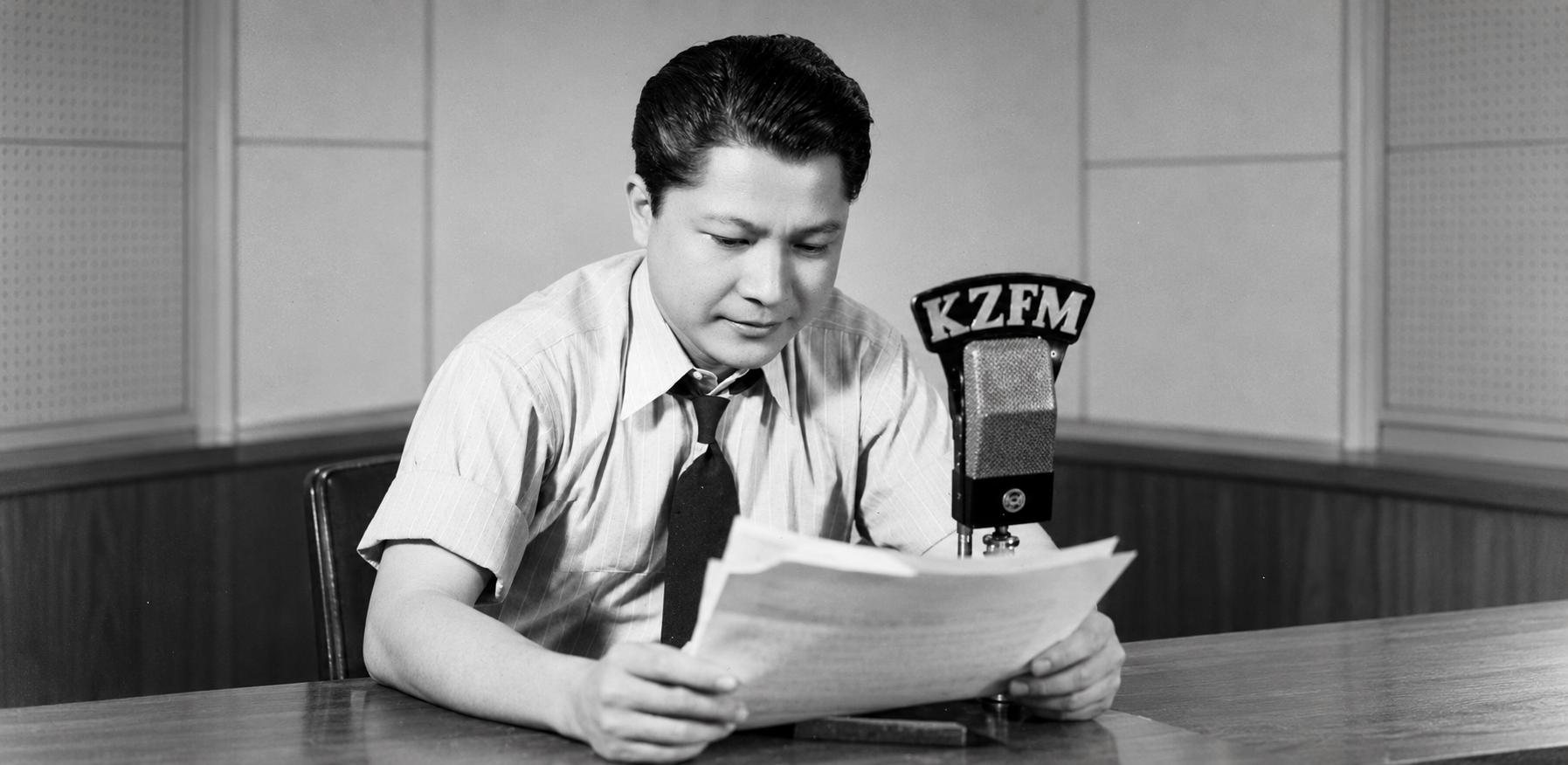
Francisco “Koko” Trinidad: A Voice, a Teacher, and a Builder of Philippine Radio
In December 1985, photographer Emmanuel Anastacio “Manny” Reyes photographed an elderly man beside a bedroom window in Cubao. The house retained the character of the 1950s, when it had been built. Reyes used the available light to capture its atmosphere. His subject was Francisco “Koko” Trinidad, a man whose working life had helped shape how Filipinos heard, produced, and understood radio.
Reyes had encountered Trinidad while making a documentary about actor Vic Silayan. According to the photographer, Trinidad had given Silayan his first radio job at the government station DZFM. It was one connection among the many that made Koko an important figure in Philippine broadcasting: careers, programs, and institutions intersected through his work.
For someone encountering his name for the first time, the familiar title “Father of Philippine Radio” needs a little explanation. Philippine broadcasting had begun in 1922, when Trinidad was still a child. The honorific recognizes his contribution to developing the profession, its public-service role, and the people who would carry it forward.
Born in Manila on October 10, 1915, Francisco Dacanay Trinidad attended Manila North High School. He later pursued law at Far Eastern University but did not complete the course. Radio became the career in which he would make his name.
He began as an announcer and program arranger at the prewar Far Eastern broadcasting company identified in his biographies. His responsibilities expanded to production coordination and eventually production management. That progression gave him experience on both sides of the microphone: delivering material to listeners and organizing the work needed to put it on air.
Published histories associate the prewar company with J. Amado Araneta’s radio interests. Today’s evangelical Far East Broadcasting Company traces its origins to a missionary organization incorporated in the United States in 1945.
When World War II disrupted Manila’s broadcasting industry, Trinidad continued working in live performance. During the Japanese occupation, he directed stage presentations at the Avenue, Lyric, and Strand theaters. The theater work placed him among the performers and production people sustaining Manila’s entertainment culture under difficult circumstances.
Following Manila’s liberation in 1945, he worked as a producer-announcer for the U.S. Office of War Information and as program director for the U.S. Information Service. The transition carried him from wartime theater into the communications work accompanying the country’s recovery and approaching independence.
In 1947, Trinidad entered Philippine government service. His career became closely associated with the Philippine Broadcasting Service, or PBS, from which he retired as general manager in 1970.
His public-broadcasting work developed around education, culture, and information useful to everyday life. Communication historians Florangel Rosario-Braid and Ramon R. Tuazon identify PBS as a pioneer in development broadcasting, citing school programs, documentaries, features, and public-affairs material. They also credit Trinidad’s leadership with regular exchanges of cultural programs with other Asian countries.
That work gave a radio station responsibilities extending beyond its daily schedule. A program could supplement classroom teaching, introduce listeners to another country’s cultural life, or explain a public issue to people who had limited access to other sources of information.
One of Trinidad’s most significant contributions was the use of radio for education.
In August 1959, PBS and the Bureau of Public Schools initiated educational broadcasts for teachers and pupils. John A. Lent’s contemporary study of Philippine radio placed the service against the needs of poorly equipped rural schools. The broadcasts offered a way to share teaching resources across distances that were difficult to overcome through ordinary classroom provision alone.
In his historical thread about Trinidad, @indiohistorian describes the influence of the British Broadcasting Corporation’s public-service and educational programming on this approach. Radio could carry structured learning as part of a broadcaster’s regular responsibility to its audience.
For a classroom with few resources, another teaching voice arriving through a receiver could matter. The arrangement still required a working radio, adequate reception, and a teacher able to connect the broadcast with classroom work. Its promise lay in making prepared educational material available beyond the place where it was produced.
Trinidad also explored educational television. A historical account published by The Philippine Star describes an early PBS television venture under his management that carried instructional programs and talk shows. The venture was short-lived and lost its broadcast frequency, but it reflected his continuing interest in using broadcasting to support learning.
The radio initiative did not survive indefinitely. @indiohistorian’s account places its closure during Martial Law, while the Asian Institute of Journalism and Communication’s biography likewise records that the Marcos government ended the educational-broadcasting effort. This occurred after Trinidad’s retirement from PBS in 1970.
Retirement from government broadcasting opened another phase of his career: teaching the people who would work in the industry.
During the 1970s, Trinidad taught at the University of the Philippines’ Institute of Mass Communication. His practical experience became part of the education of aspiring broadcasters.
One former student left a particularly clear record of that influence. In her 2005 conference paper, Philippine Radio: A Short History of a Medium in Crisis, Amy L. Forbes explained that much of her historical material came from notes she had taken as Trinidad’s radio student in 1979.
The acknowledgment makes his teaching legacy tangible. A student’s classroom notes remained useful decades later, becoming a resource for explaining Philippine radio to another audience.
His involvement with UP extended to the institution’s development. @indiohistorian credits Trinidad with helping secure the institute’s elevation to college status. UP’s own history records the Board of Regents’ approval on April 28, 1988. The resulting College of Mass Communication is now known as the College of Media and Communication.
UP also recognized his contribution through a testimonial plaque and a certificate of appreciation. The acknowledgments reflected the institutional work that accompanied his teaching.
His later appointments continued to connect broadcasting, education, and culture. In April 1986, he became secretary-general of the UNESCO National Commission of the Philippines, serving until 1990. He also worked as program director of Radio Veritas Asia’s international service. His departure from PBS had therefore not ended his professional life in communication.
Beyond the institutions was a family deeply involved in the arts and media.
His wife, Carolina Flores-Trinidad, was known professionally as Lina Flor. A writer and radio dramatist, she created Gulong ng Palad, one of the enduring titles in Philippine popular storytelling. Her achievement was an important part of the same radio world in which Koko worked, with audiences following characters and their changing fortunes through sound.
Their son Noel Trinidad began as a radio voice actor before developing a career in theater, television, and film. For readers who recognize Noel from comedy or screen drama, Koko’s story reveals the broadcasting roots behind a familiar entertainment name.
Another son, Francisco “Corky” Flores Trinidad, became an editorial cartoonist whose work appeared in the Honolulu Star-Bulletin. Writing, acting, broadcasting, and visual commentary all became part of the family’s contribution to public life.
Koko himself also appeared in films. His later screen credits included Madrasta (1996) and Lagarista (2000). Some viewers encountered him as an actor without knowing the earlier broadcasting career behind the face on screen.
The Cubao portrait provides a quieter glimpse of the man. Reyes recalled that Trinidad liked the photograph and subsequently recommended him for a photography-contest jury associated with the ASEAN Cultural Centre in Tokyo in 1987. It was a personal gesture of encouragement, recorded by the photographer who benefited from it.
Koko Trinidad died on January 21, 2001, aged 85. A contemporary notice in The Philippine Star reported that his wake was at Christ the King Church in Green Meadows, Quezon City.
A revealing part of his legacy survives in his own comments about audiences.
Interviewed for Lent’s research in 1965, Trinidad objected to broadcasters using supposedly limited audience tastes as an excuse for poor programs. He challenged the assumption that mass listeners could not appreciate better work.
“I get very resentful when I hear a media man say the bakya tastes cannot be raised,” he said.
That conviction helps connect his educational broadcasts, production work, and teaching. Listeners deserved thoughtful material, and the people making it needed the preparation to deliver it. Across those different jobs, Koko Trinidad kept returning to the relationship between the broadcaster’s craft and the public it served.



Advertisement


Log in to join the discussion and leave a comment on this article.
Log in to Comment